
Unlock Your Salesforce Potential.


Solutions
Company
resources
Partners


Trusted by regulated enterprises worldwide


Stay Validated Without the Validation Overhead
Flosum is built for risk-based CSA and GAMP 5 approaches — with the qualification documentation, controlled SDLC, and change evidence your quality team leverages instead of recreates. Your Vault and CRM environments stay in a validated state release after release, while the effort of qualifying the tool itself shrinks to a fraction of the norm.
Make Compliance the Path of Least Resistance
Approval workflows, electronic signatures, and enforced controls are embedded in the release pipeline itself — mapped to 21 CFR Part 11, EU Annex 11, and ALCOA+ expectations. Teams move at full speed because the compliant way to ship a change is also the easiest way.
Deploy at Enterprise Scale — Beyond the 200-Component VPK Ceiling
Manual VPKs, Vault Compare reports, and spreadsheet tracking break down on large, interdependent releases. Flosum's metadata-aware version control and dependency-safe pipelines deploy changes of any size — no blocked packages, no manual reordering, no lost history.
Answer Any Auditor in Minutes, Not Weeks
Every change carries an immutable, time-stamped record of who changed what, who reviewed it, who approved it, and when it deployed — with segregation of duties enforced automatically. When inspectors ask, you export the evidence instead of reconstructing it.
Move at Agent Speed Without Losing Control of Change
Veeva AI Agents mean non-human actors will soon propose configuration changes in your regulated environments. Flosum routes every change — human or AI-initiated — through the same version control, approval, and rollback pipeline, so agentic speed never outruns your audit trail.
Automate Complex Deployments with Precision
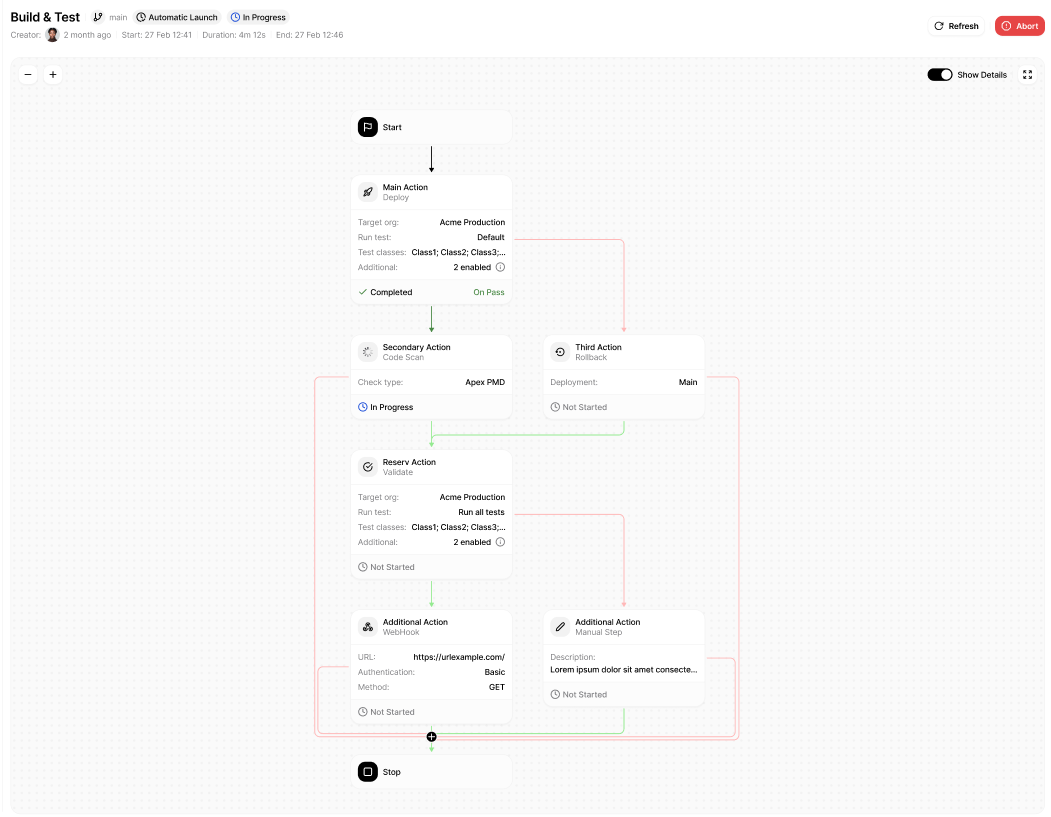
Governed automation ends the trade-off between velocity and compliance. Replace manual migrations and error-prone VPKs with Flosum's intelligent pipelines. You can deploy massive, interdependent releases seamlessly—ensuring every change is versioned, tested, and instantly reversible.

Bristol Myers Squibb runs Salesforce across 6 to 10+ production orgs supporting a GxP-validated change process — every release needs traceability from requirement to deployment before it can touch a regulated environment. A missed window doesn’t just slip a sprint; it can slip a filing.
Flosum’s Native DevOps package gives Bristol Myers Squibb’s team the same metadata-aware version control, CI/CD automation, and environment management used across their Salesforce orgs, so validated releases ship on the timeline the business — and the regulator — expects.

Git is optional, not mandatory. Connect the tools your team already uses — Flosum slots into your pipeline without re-platforming.
Qualification documentation, a controlled SDLC, and change evidence mapped to GxP, GAMP 5, 21 CFR Part 11, EU Annex 11, and CSA expectations — generated automatically in the release pipeline.
Veeva Vault DevOps is the practice of managing, versioning, deploying, and governing configuration and metadata changes across Veeva Vault environments using controlled, auditable release pipelines instead of manual migrations. It brings version control, automated deployment, testing, rollback, and audit trails to Vault so life sciences teams can release faster while maintaining GxP control.
Veeva Vault does not provide native Git-based version control or one-click pipeline deployment. Configuration changes are moved between Vaults using Configuration Migration Packages (VPKs), Vault Compare reports, and MDL, and change tracking is largely manual — which is the gap dedicated DevOps tooling fills.
A Veeva Vault outbound Configuration Migration Package (VPK) is limited to 200 components per package. Larger or interdependent releases must be split into multiple packages and re-validated, and circular dependencies between components can produce a "Blocked" deployment status — a common source of manual rework that automated DevOps tooling manages for you.
Veeva CRM (the Salesforce-based product) reaches end of support on December 31, 2029—a deadline moved up from the originally planned September 2030 date. With Vault CRM now generally available, life sciences organizations must accelerate their migration plans between 2026 and 2029 to ensure uninterrupted, compliant operations.
The Veeva CRM to Vault CRM migration is Veeva's move of its CRM application off the Salesforce platform onto its own Vault Platform. It is a validated re-implementation — not a lift-and-shift — requiring data and configuration migration, integration rebuilds, and change management across both platforms until legacy Veeva CRM support ends on December 31, 2029.
Copado and Gearset are Salesforce DevOps tools; Copado's Veeva support targets Veeva CRM on the Salesforce platform, and Gearset is Salesforce-only. Neither offers DevOps for the Veeva Vault Platform's native configuration model, which is why dedicated Vault Platform tooling is required.
Flosum provides one governed change-management platform spanning both legacy Veeva CRM and the Veeva Vault Platform, so teams can run controlled, audited releases across both during the migration. This unified coverage lets organizations govern the entire CRM-to-Vault transition from a single system of record.
For 21 CFR Part 11, DevOps tooling should provide secure, computer-generated audit trails with user ID and timestamp, electronic-signature-backed approvals, access controls, and traceable change history for every configuration change. Flosum captures this evidence automatically for changes across Veeva Vault and Veeva CRM.
DevOps tooling supports GxP and GAMP 5 by enforcing a controlled, risk-based change lifecycle — specification, review, testing, approval, and traceable deployment — that produces the documentation needed to demonstrate a system stays in a validated state. GAMP 5 (Second Edition, 2022) explicitly encourages leveraging supplier tooling and evidence to reduce validation effort.
Computer Software Assurance (CSA) is the FDA's modernized, risk-based approach to computer system validation, recently finalized and aligned with the new QMSR. It emphasizes critical thinking and unscripted testing over exhaustive documentation for lower-risk functions. For DevOps tooling, CSA means you can scale your validation effort based on risk and rely heavily on vendor-provided evidence—drastically reducing the burden of qualifying the Flosum release platform itself.
You maintain an audit trail for AI-generated changes by routing every proposal from an AI agent through the same version control, review, and approval pipelines used for human developers. With Veeva AI Agents now active across Vault CRM and PromoMats, it is critical to ensure every automated action has a complete, immutable lineage. Flosum ensures that inspectors see reconstructable, compliant records, rather than just conversation logs.
Veeva Vault does not offer native Git-style branching or automated rollback of configuration; recovering from a bad change typically means manual re-migration. A metadata-aware DevOps platform adds true version history and reversible deployments, so you can roll back a Vault or Veeva CRM change to a known-good state.
A well-designed DevOps tool should reduce net validation effort, not add to it, by supplying supplier documentation, a controlled SDLC, and audit-ready change evidence you can leverage under a risk-based CSA/GAMP 5 approach. The validation burden of the tool itself is a key evaluation criterion — ask vendors for their qualification package and change-management/SDLC evidence up front.
Life sciences companies need DevOps during the migration because they must operate and change two live, regulated platforms simultaneously — legacy Veeva CRM and Vault — without losing audit control or missing the December 31, 2029 deadline. Governed pipelines across both platforms reduce migration risk, prevent uncontrolled changes, and provide the evidence auditors expect throughout the transition.
Metadata-aware version control tracks the specific configuration components and their dependencies — not just files — so it understands relationships between objects, fields, lifecycles, and workflows. For Veeva, this prevents the broken dependencies and manual reordering that plague 200-component VPK migrations and gives you a precise, reversible history of every change.


