

Security practices designed for annual release cycles fail when Salesforce teams deploy changes weekly or daily. The gap between development speed and security review creates a predictable pattern: either releases slow dramatically while awaiting approval, or vulnerabilities slip through to production undetected.
DevSecOps eliminates this tradeoff. By embedding security into every stage of rapid, integration-heavy delivery cycles, organizations can ship faster while strengthening trust, compliance, and resilience across their Salesforce ecosystem. For Salesforce development specifically, this integration is essential: metadata-driven architectures, multi-tenant environments, and complex declarative configurations create risks that checkpoint-based security reviews consistently miss.
The adoption data reflects this shift. According to a Gartner survey of information security, software engineering, and IT leaders, 50% of organizations have implemented DevSecOps practices. Among the motivations for adoption, 48% of organizations implemented DevSecOps specifically because security audits were causing release delays. Another 39% were motivated by the need for greater security overall.
This article explains how DevSecOps principles apply to Salesforce development, covering platform-specific security considerations, implementation strategies, and approaches for integrating automated controls that protect without impeding delivery velocity.
What DevSecOps Means for Salesforce Development
Salesforce operates under a shared responsibility model. The platform secures infrastructure, data centers, and core services. Organizations remain responsible for securing their own data, metadata, custom code, and integration points. DevSecOps addresses this responsibility by building security controls directly into the development workflow rather than treating them as a separate review process.
Three characteristics of Salesforce development make this integration particularly important:
- Metadata-driven architecture: Configuration changes carry the same risk as code changes. A modified permission set or sharing rule can expose data just as effectively as a coding flaw, yet declarative changes often bypass traditional code review processes.
- Multi-tenant environment: Custom code executes within Salesforce's shared infrastructure, meaning vulnerabilities can have platform-wide implications. Governor limits and security controls exist specifically because tenant isolation depends on code behaving correctly.
- Integration density: Most Salesforce implementations connect to external systems through APIs, middleware, and third-party applications. Each connection point creates potential exposure that must be secured without blocking the data flows the business requires.
These factors explain why security checkpoints at deployment consistently miss risks that accumulate earlier in the development process. DevSecOps represents a fundamental shift from security-as-gate to security-as-foundation, embedding protective measures throughout development rather than applying them at the end.
How DevSecOps Differs from Traditional Salesforce DevOps
Traditional Salesforce DevOps treats security as a checkpoint before production deployment. DevSecOps treats security as a continuous process embedded throughout development. This distinction shapes four operational differences.
When Security Happens
Traditional approaches conduct security reviews after development completes, often days or weeks before a scheduled release. DevSecOps integrates security validation during coding through tools like Static Application Security Testing (SAST) that analyze code as developers write it.
For DevOps engineers managing Salesforce deployments, this means static code analysis runs automatically when developers commit Apex code. Issues surface when they cost minutes to fix rather than hours to unwind from dependent components.
Who Owns Security
Traditional approaches concentrate security responsibility in a dedicated team that reviews work produced by others. DevSecOps distributes security accountability across everyone who touches the code: developers run security scans locally, release managers verify security gates pass before promotion, and operations teams monitor for runtime vulnerabilities.
This distribution transforms security from a function that blocks deployments into expertise embedded where vulnerabilities actually form.
How Compliance Works
Traditional approaches demonstrate compliance through completed checklists: every item checked, every form signed. DevSecOps demonstrates compliance through systematic processes: automated scans that run on every commit, audit trails that capture every deployment decision, risk assessments that evaluate each change in context.
The difference matters when auditors arrive. Checklists prove a point-in-time review occurred. Automated processes prove that security controls operated continuously.
How Maturity Develops
Traditional security capabilities often remain static once implemented. DevSecOps capabilities develop incrementally as teams build confidence with automated controls, expand coverage to additional vulnerability types, and extend practices across more development teams.
Organizations typically require three to five years of sustained investment before DevSecOps practices reach full maturity across all Salesforce development workflows.
Security Challenges Unique to Salesforce
Salesforce's metadata-driven architecture, declarative development model, and multi-tenant cloud infrastructure create security challenges that traditional application security frameworks do not address.
Metadata as an Attack Surface
Metadata represents a security surface that does not exist in traditional application development. A profile change deployed without proper review can grant field-level access to sensitive data across thousands of records. A permission set modification can expose entire object categories. A sharing rule adjustment can make private records visible organization-wide.
These configuration changes carry the same risk as code vulnerabilities but often bypass security review because they do not look like code. DevSecOps addresses this through automated metadata scanning integrated into deployment pipelines that detects permission escalations before they reach production.
OAuth Token and API Exposure
Salesforce implementations typically connect to dozens of external systems through APIs, each connection authenticated through OAuth tokens. Compromised tokens grant attackers the same access as legitimate integrations, often with broad permissions that span multiple objects.
Recent breach patterns demonstrate how attackers target these tokens specifically. Social engineering campaigns harvest credentials that unlock API access, enabling systematic data exfiltration without triggering traditional intrusion alerts. DevSecOps practices address this through automated token lifecycle management, OAuth flow testing, and continuous monitoring for anomalous API access patterns.
Custom Code Vulnerabilities
Apex and Visualforce introduce vulnerability classes specific to the Salesforce platform. SOQL injection allows attackers to bypass object and field-level security by manipulating dynamic queries. Cross-site scripting in Lightning Web Components can execute unauthorized code in user browsers. Insecure direct object references can expose record IDs that attackers enumerate to access unauthorized data.
These vulnerabilities require SAST tools configured specifically for Salesforce syntax and security models, not generic code scanners designed for other languages.
AI Agent Prompt Injection
Agentforce and similar AI capabilities introduce prompt injection as an emerging vulnerability class. Attackers can embed malicious instructions in web forms, case comments, or other user-submitted content that AI agents process. When agents execute these instructions, they can exfiltrate CRM data or perform unauthorized actions with the agent's elevated permissions.
This vulnerability class requires testing approaches that did not exist twelve months ago. DevSecOps teams must now validate AI agent behavior alongside traditional security controls.
Sandbox Data Exposure
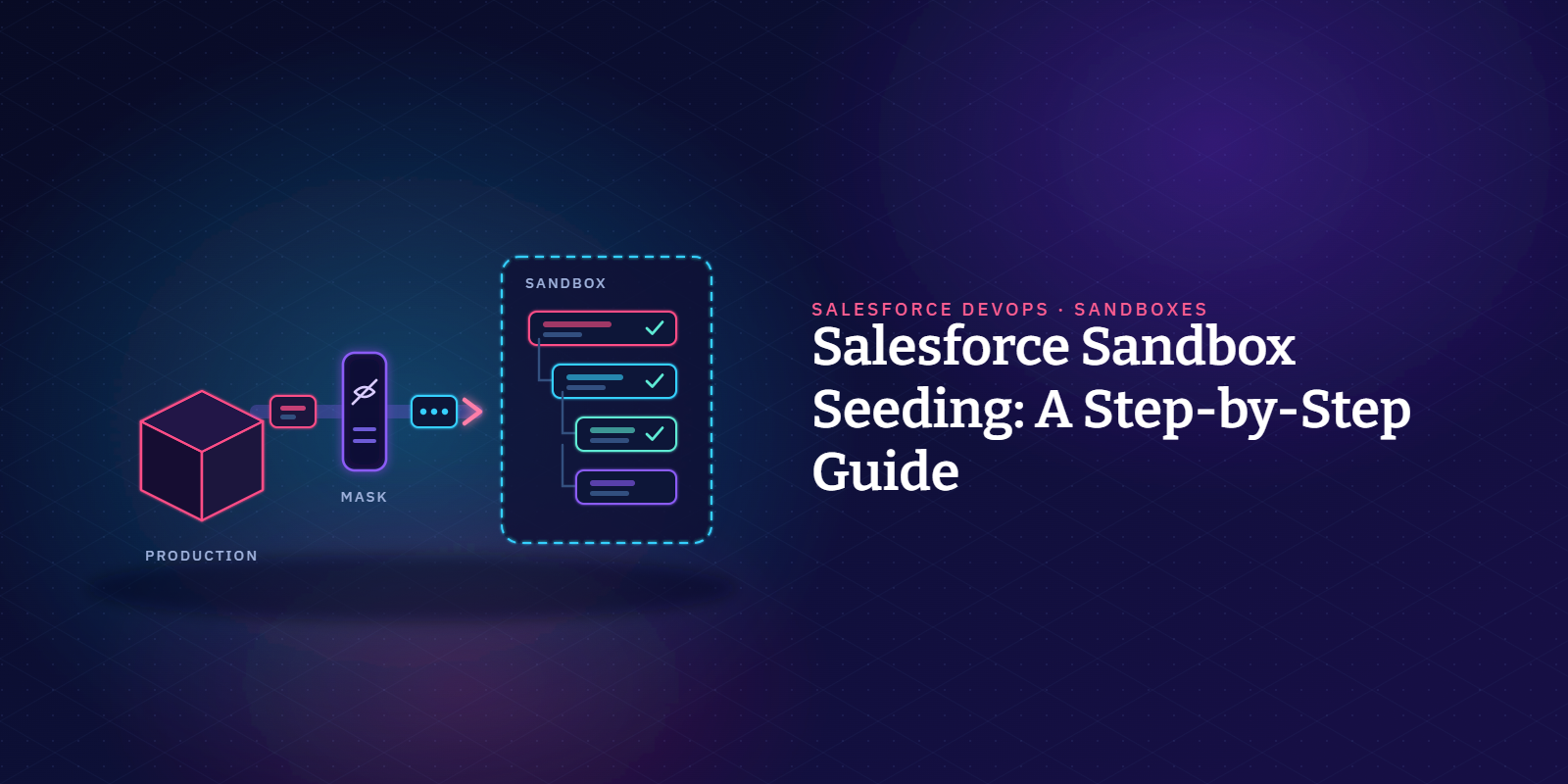
Sandboxes replicate production data and metadata into development environments. Without proper data masking, developers gain access to real customer information they need only structurally, creating compliance violations and unnecessary exposure.
DevSecOps addresses this through automated data masking integrated into sandbox refresh processes, ensuring developers work with realistic data structures without accessing actual customer records.
Core DevSecOps Practices for Salesforce CI/CD
Implementing DevSecOps in Salesforce environments requires three foundational practice categories: framework alignment, automated security testing, and compliance artifact generation. These practices transform the security challenges outlined above into preventable risks through systematic automation.
NIST Secure Software Development Framework Foundation
The NIST Secure Software Development Framework provides the authoritative structure for implementing DevSecOps practices across any development environment, including Salesforce. This framework organizes security practices into four distinct areas that address the complete software lifecycle from preparation through vulnerability response. Understanding these practice areas clarifies how DevSecOps moves beyond ad-hoc security measures into systematic protection.
Prepare the Organization
Organizations ensure their people, processes, and technology are prepared to perform secure software development. According to NIST SP 800-218, this practice area requires organizations to "ensure that their people, processes, and technology are prepared to perform secure software development at the organization level."
For Salesforce teams, this includes defining security requirements for field-level security configurations, authentication requirements, and compliance mandates, as well as ensuring personnel are trained on secure development practices and that organizational security policies are established.
Protect Software
This practice area focuses on protecting all components of software from tampering and unauthorized access throughout the development lifecycle. For Salesforce environments, protection mechanisms must extend beyond code to include the metadata and configurations that define organizational behavior.
This includes version control for Salesforce metadata and security configurations, ensuring every permission change and configuration update maintains an auditable history.
Produce Well-Secured Software
Organizations produce software with minimal security vulnerabilities in releases through systematic design and verification practices. According to NIST SP 800-218, this practice area requires designing software securely and verifying security through comprehensive reviews and testing.
Organizations implement automated security testing tools such as SAST, DAST, and SCA into Salesforce CI/CD pipelines, though NIST emphasizes integrating appropriate security controls and testing throughout the software development process rather than mandating specific tools.
Respond to Vulnerabilities
Organizations identify residual vulnerabilities in their software releases and respond appropriately to minimize exposure windows. According to NIST SP 800-218, practice area RV requires organizations to "identify residual vulnerabilities in their software releases and respond appropriately."
For Salesforce, this includes continuous monitoring of installed package versions, automated alerts for security advisories, and regular review of package permissions integrated into DevSecOps workflows.
Automated Security Testing and Analysis
Automated security testing integrates vulnerability detection directly into Salesforce CI/CD pipelines, identifying security flaws in code, configurations, and metadata before they reach production environments. This automation enables continuous security validation without manual review bottlenecks, allowing development teams to maintain deployment velocity while enforcing security standards.
The official Salesforce Code Analyzer "analyzes multiple languages including Apex, JavaScript, HTML, CSS, and Salesforce metadata such as Flows." Critically for AppExchange partners, "You're also required to upload your Salesforce Code Analyzer scan reports" for security review. This tool provides native integration with Salesforce development workflows, scanning both declarative configurations and custom code within a single security validation process.
For Salesforce environments, automated security testing includes specialized SAST tools configured for Apex and Visualforce syntax, DAST for runtime vulnerability detection in Lightning components, SCA for third-party package dependency analysis, and metadata security scanning to detect permission escalations or sharing rule misconfigurations before deployment.
Automated Security and Compliance Artifact Generation
DevSecOps pipelines automatically generate audit evidence and compliance documentation throughout the development lifecycle, eliminating manual compilation before audits. This continuous artifact generation creates immutable records of security controls, code reviews, deployment approvals, and testing results that satisfy regulatory requirements across multiple frameworks.
According to NIST SP 800-218, organizations must "Configure tools to generate artifacts of their support of secure software development practices as defined by the organization." The CISA guidance explains this practice is mandated by OMB Memo M-22-18, requiring software producers selling to the U.S. federal government to attest that their software was developed following secure practices aligned with the NIST SSDF.
For compliance managers, this means DevSecOps pipelines automatically generate audit evidence rather than requiring manual documentation compilation before each audit. These artifacts include automated security scan results, deployment approval chains, code review records, and configuration change logs that demonstrate continuous compliance rather than point-in-time certification.
Regulatory Compliance Through DevSecOps
DevSecOps practices establish a unified control framework that simultaneously satisfies requirements across SOC 2, GDPR, HIPAA, and NIST 800-53 through common security controls rather than separate compliance programs. This consolidation reduces audit preparation time while maintaining comprehensive regulatory coverage.
Unified Control Framework Across Multiple Regulations
Organizations can satisfy multiple regulatory requirements simultaneously by implementing security controls that address common requirements across different compliance frameworks. Rather than building separate compliance programs for SOC 2, GDPR, HIPAA, and NIST 800-53, DevSecOps establishes shared controls for access management, audit logging, and data protection that map to all frameworks at once.
According to the Cloud Security Alliance, control frameworks provide best practices designed to manage and mitigate specific cybersecurity risks. Common control families across regulatory frameworks include access control requirements, audit logging and monitoring, and data protection and encryption.
Organizations implementing comprehensive access controls, audit logging, and encryption within Salesforce DevSecOps pipelines simultaneously satisfy requirements across multiple regulatory frameworks rather than building separate compliance programs for each regulation. These unified controls include automated reviews of profiles, permission sets, and sharing rules; SAST and DAST integrated into CI/CD pipelines; version-controlled metadata and security configurations; formal approval workflows with documented change trails; and comprehensive audit logging through Salesforce Event Monitoring and Setup Audit Trail.
SOC 2 Trust Services Criteria
SOC 2 compliance evaluates how organizations protect customer data through five trust service criteria, with DevSecOps controls directly mapping to security, availability, and confidentiality requirements. Salesforce-specific implementations must address role-based access controls, code security, and audit trail generation to satisfy SOC 2 auditor expectations.
According to the AICPA's official SOC 2 framework, SOC 2 examinations evaluate management's service commitments against five Trust Services Criteria: security, availability, processing integrity, confidentiality, and privacy.
PwC's Salesforce Cloud Security Services specifies organizations must evaluate role-based access control security including profiles, permission sets, and record-level security, along with Apex source code security for user access risks. SOC 2 requirements are satisfied through the unified control framework described above.
GDPR Data Protection Requirements
GDPR mandates specific data protection practices including consent management, data minimization, and the right to erasure, with DevSecOps automating many compliance controls that would otherwise require manual intervention. Salesforce organizations must implement technical measures for data masking, encryption validation, and access monitoring to demonstrate GDPR compliance.
ISACA's Privacy Principles provides guidance that information assurance professionals can use in conjunction with GDPR requirements. According to Salesforce's Cloud Security Framework, cloud security frameworks help businesses stay compliant with GDPR by providing structured guidelines for data protection in cloud deployments.
GDPR-aligned DevSecOps practices include automated data masking and anonymization for sandbox environments (addressing the sandbox security challenge discussed earlier), encryption validation through automated testing, continuous monitoring of who has access to personal data fields, and compliance gates in deployment pipelines that validate consent tracking and data retention policies.
While regulatory compliance provides the mandated baseline for DevSecOps implementation, organizations also need quantifiable evidence that these practices deliver measurable business value beyond satisfying auditors.
Measurable Outcomes from DevSecOps Implementation
Organizations implementing DevSecOps report significant reductions in security incident response effort and compliance preparation time. According to Gartner Peer Community research, the majority of respondents report fewer security incidents after DevSecOps implementation, and 63% of organizations that have implemented or are implementing DevSecOps incorporate defense-in-depth practices as part of their strategy.
A Forrester Total Economic Impact study found organizations managed and mitigated security risks with 81% less effort compared to traditional security approaches, with software development teams spending approximately 3.85% of annual work time supporting auditing and compliance efforts—a significant reduction from manual compliance documentation processes.
These measurable improvements demonstrate that DevSecOps delivers tangible operational value beyond conceptual security benefits, reducing both security incident costs and compliance overhead while maintaining development velocity.
Understanding DevSecOps's Role in Secure Salesforce Development
Security checkpoints that block deployments create a predictable outcome: teams either slow down to wait for reviews or find ways to bypass them. DevSecOps eliminates this tradeoff by making security automatic, continuous, and invisible to developers focused on delivering features.
The organizations that ship fastest are not the ones that skip security. They are the ones that embedded it so deeply into their workflows that protection happens without friction. For Salesforce development teams managing complex deployments across multiple environments, DevSecOps provides the operational framework to maintain security standards while delivering features at the pace business demands.
Request a demo with Flosum to explore how integrated DevSecOps capabilities can strengthen security across your Salesforce development lifecycle while accelerating compliant deployments.

Thank you for subscribing