
Unlock Your Salesforce Potential.


Solutions
Company
resources
Partners



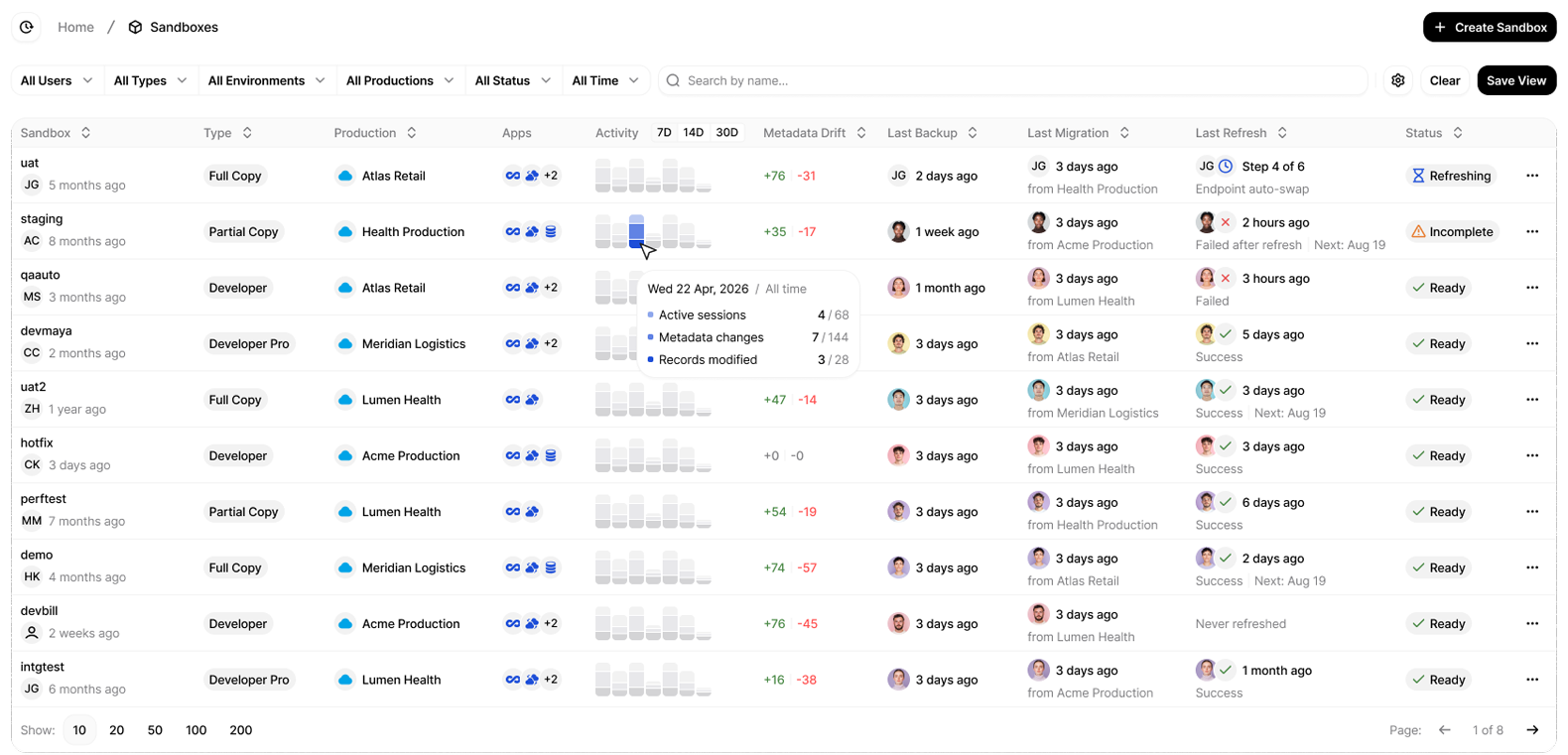
Developer sandboxes, provisioned in clicks
Every new sandbox ships pre-configured: Flows disabled, PII masked, production data seeded, access locked down — automatically, on every new sandbox. No manual setup, no accidental emails, no exposed data.
Full-copy sandboxes that never go
stale
Keep your sandbox continuously in sync with production. The 29-day refresh window stops mattering. The months-long refresh project goes away.
Fewer full-copy sandboxes
Continuous sync means you need fewer of the most expensive licenses in your contract.
Developers back to building
No more weeks lost to environment setup. Your team spends its time on the work that matters.
Turn every developer sandbox into a full-data sandbox
Flosum auto-migrates masked production data into every developer sandbox and keeps it continuously in sync — full-copy realism, without the full-copy license.
Lower total cost of ownership
Provisioning, masking, seeding, and governance in one license. No stitched-together tooling.
Provisioning, masking, seeding, and governance in one license — wired into the pipeline you already run.
Audit trails, segregation of duties, and approval controls that satisfy SOX, HIPAA, GxP, 21 CFR Part 11, and DORA requirements — generated automatically in the release pipeline.
Salesforce sandbox management is the practice of provisioning, configuring, seeding, securing, and refreshing Salesforce sandbox environments so teams can develop and test in production-like conditions without touching production data. It spans developer sandbox setup, test data seeding, data masking, access control, and keeping full-copy sandboxes current. Flosum automates the full lifecycle — from few-click provisioning of developer sandboxes to continuous synchronization of full-copy sandboxes with production.
Creating a developer sandbox takes minutes, but making it usable typically takes weeks: teams manually configure settings, load and mask test data, disable automations, and restrict access. Flosum Sandbox Management compresses that work into a few clicks, delivering a pre-configured, seeded, masked, and access-controlled sandbox in minutes.
Salesforce permits a full copy sandbox refresh once every 29 days. In practice, reconnecting integrations after each refresh often stretches cycles to several months, leaving both data and metadata stale. Flosum keeps full-copy sandboxes continuously in sync with production, so manual refreshes become the exception rather than a recurring project.
The reliable approach is templatized data migration: select a representative subset of production records, load them with relationships intact, and mask sensitive fields before anyone works in the environment. Flosum Data Migrator moves a defined subset of production data into developer sandboxes, and Flosum Data Masking anonymizes sensitive data at rest — both built into Sandbox Management provisioning.
Disable flows and mask contact and user email addresses during provisioning — before anyone logs in. Flosum Sandbox Management does both automatically: it disables all flows so automations don't fire unintentionally, and masks contact and user information so test activity can't trigger outbound emails to real customers.
Enterprise Salesforce editions include 25–100 developer sandboxes, yet most sit idle because each one takes days or weeks of manual configuration, data seeding, and masking before it's safe to use. When provisioning takes longer than the work itself, developers share environments or skip sandboxes entirely. Automated provisioning removes that setup tax so the sandboxes you already pay for actually get used.
Two ways: fewer full-copy sandboxes, and higher utilization of what you already own. When full-copy sandboxes stay continuously in sync with production, teams need fewer of them — reducing licensing costs. When developer sandboxes provision in minutes, the 25–100 included with enterprise editions stop going to waste. The result is lower total cost of ownership for the same or greater development capacity.
Masked sandbox data lets developers work with realistic records while sensitive values are anonymized at rest. Flosum Sandbox Management masks data in both developer and full-copy sandboxes and applies security settings that restrict each sandbox to a minimal set of users — supporting compliance programs such as GDPR, HIPAA, and GxP across financial services, healthcare, and life sciences.
Yes. Provisioning includes reconnecting each new sandbox to your Flosum pipeline topology, so branches, deployments, and release workflows recognize the environment immediately — no manual re-wiring between your sandbox strategy and your DevOps process.
Salesforce provides sandbox creation and a refresh mechanism; the configuration, seeding, masking, security, and integration work that makes a sandbox usable remains manual. Flosum automates that entire layer — pre-configuration, flow disabling, data seeding and masking, access restriction, and DevOps reconnection in a single provisioning workflow — plus continuous production sync for full-copy sandboxes.
Archiving moves inactive, aging records out of premium Salesforce storage into lower-cost storage you control, while keeping them accessible for audits and reporting. Additional Salesforce data storage costs $125 per 500MB per month — about $3,000 per year per 10GB — versus roughly $0.023 per GB monthly for cloud archival storage. Flosum archives with policy-driven retention and in-place query access.
Autonomous AI agents read, write, update, and delete Salesforce data at machine speed, so a single misconfiguration, over-broad permission, or prompt-injection attack can corrupt large volumes of records quickly. Noma Security's disclosed "ForcedLeak" vulnerability (CVSS 9.4) showed indirect prompt injection is a real Agentforce attack surface. This raises the need for high-frequency backups, change intelligence, and granular point-in-time restore.
Flosum supports HIPAA and GDPR obligations and lists ISO 27001, ISO 27017, ISO 27018, SOC 2 (Trust Services Criteria), NIST 800-series alignment, PCI Level 1, and GDPR/U.S. Data Privacy Framework among the standards it meets or exceeds. It provides encryption, customer-managed keys, retention, and right-to-erasure support.
With Flosum, backup data can live in an environment you control — your own AWS, GCP, Azure, or private VPC — under your encryption keys, supporting data-residency requirements. This deployment flexibility keeps your backups independent of the platform they protect, which matters for sovereignty, DORA segregation, and vendor concentration risk.
Yes. Flosum performs granular restore at the record, field, and object level with relationship integrity preserved, so you recover exactly what broke without over-recovery or triggering unnecessary downstream automation. Selective restore matters because mass restores can fire thousands of workflows and create secondary failures.


